Sunday, February 21, 2016

On the Road (Again or Still?)

Much of last year was spent traveling for a mixture of projects.  Not all of them were for photography but I tried to sneak a camera into my limited carry-on space when I could.  Here are some of the numbers:

177 nights in a bed other than my own

61,083 miles in the air

83 take offs (and thankfully the same number of landings)

15 different rental cars

Uncounted bags of free, Southwest peanuts
 
This year looks similar with perhaps fewer days away from home but likely as many miles in the air.  However, my plan for 2016 is to find a way to bring more camera gear and share more photos.  My project for last year, however, was more limited to the airports.  The collage above (click for a larger view) is of my shoes in airports around the country.  See if you recognize any from your travels.  The carpet in Portland International Airport (PDX) was changed last year and it stirred up quite a bit of sentimental feelings in the community.  Yes over new carpet.  The airport stores feature a wide selection of gifts featuring the old (and some with the new) carpet designs.  Mugs, t-shirts, stickers, even jewelry sport the now mostly replaced carpet (there are still a few pieces hiding around the terminals). 

Look for more travel photography this year and stories from the road.  First up Memphis, TN – the Bay Area (after the Superbowl) – and Pennsylvania.  
 
Follow the Light,
 
Will

Tuesday, May 26, 2015

Camera Straps for Comfort

One piece of equipment that can make your photo excursions more comfortable is a proper camera strap.  I have a drawer full of brand new straps that accompanied my cameras as I unpacked the boxes.  This is not to say that all straps that are included are bad, I just find the straps with new cameras are too rigid for me.

Straps are definitely a matter of personal choice and what one person finds perfect may be completely uncomfortable on someone else.  Because we do a lot of hiking and travel, I have discovered straps that have some give cut into my shoulder less and make for more pleasing long days with heavy equipment around my neck. 

There are several factors to consider: the weight of your gear, how long you will have the camera dangling from you, cost and how much security you need are just a few considerations.  If you have lighter bodies and lenses and are not planning on long days, then a more rigid strap may suit you fine.  Several innovative straps have been introduced to the market over the past several year that provide different ways of carrying cameras.  Some screw into the tripod mount on the bottom of the body.  Others provide extra security when you will be moving about.  Scanning through camera magazines or online provide many options.

After trying several different straps over the years (many of them pretty good as well) our go to strap are ones made by OP/Tech (Super Pro) and Tamrac (Boomerang).  These straps are made of combination of neoprene mixed with an elastic strap.  For me these provides a comfortable surface on my shoulder and neck while slightly stretching (and not digging in) while on treks.  The straps come in different styles and colors and are reasonably priced. 

After leading several workshops where we put some miles on our boots, I have heard more than one photographer complain about needing to get a new strap or discussing a better way to carry their camera.  This is one of the lowest cost investments to improve your quality of life while packing a camera especially, if you are one of the photographers whispering to yourself that there has to be a better way to haul your glass around!

Check out local camera stores as I have found many of them carry a variety of different brands and styles.  Make sure the part where the strap attaches to the camera body is well made and sturdy (another thing I like about the OP/Tech and Tamrac straps). 

For disclosure, I’m not paid by OP/Tech or Tamrac, nor have they every given me free equipment (I haven’t asked them for any either).  I just wanted to share about equipment I actually use and that works for me. 

These straps have several hundred miles on them

Friday, May 22, 2015

Don’t Miss Spring!


Since I’ve been travelling around the country quite about over the first part of the year it has been interesting to notice the different “start times” for spring.  In Oregon we are right in the mix; the early season blubs are long gone and tulips finishing up.  The blue iris along the front of the yard are going strong.  Roses are budded out and just started to explode with their color.  My first peony opened with amazing splendor and everything is green of course…it’s Oregon.

In California many of the roses are nearing their second bloom and it seems like I’ve been catching wildflowers on display for months.  Traveling through Michigan, Ohio and Indiana over the past few weeks and many of the trees are still struggling to leaf out.  This, of course, is natural…they are not all in sunny Southern California after all.

But before you know it spring will be gone and we will be thinking about summer plants and landscapes.  Let’s agree that we won’t miss spring this year.  We need to spend some time in public gardens, parks and even our own yards before it is too late and we miss some great expression of nature, forcing us to wait another year for the show.  So grab those cameras and venture out.  Find some pleasing subjects along with great light and click away. 

Try something new with your equipment as well.  Try using a tripod.  Not only will it hold your camera still, but it also forces you to slow down and better frame your images.  Get your camera closer to the ground for a different background perspective.  If spring is going to give us all of this color and great subjects the least we can do is stretch our creativity a bit.

Here are a few images I’ve captured in the garden recently.  Even if you walk outside with the intent to take a few frames and come back empty handed (like I frequently do) at least we can enjoy the outdoors for a moment.

Tuesday, April 21, 2015

Familiarity breeds...better images.

Okay, that may not be what the 600 year old saying actually says but it’s still true.  This is a major topic early on when I lead travel photography workshops.  Frequently photographers share that they are not as happy with their travel images compared to photos they capture at more familiar environs around home.  I am reminded of this topic as I sit in the Sacramento Airport waiting for a flight.

To explore this more deeply during the travel workshops I use a little activity to drive this concept home.  Handing out for postcards of the State Capitol building in Sacramento, I ask the photographers what each of these images have in common, other than the obvious building as the primary subject.  The cards are passed around, some good guesses are made but I have yet to have anyone figure out the answer.  Then I tell them to turn the cards over and look for the photo credit (it’s not me by the way).  All the photos were taken by the same photographer.

The images are from different times of the year, from various angles and under a variety of lighting conditions.  The photographer clearly “worked” the subject and, in doing so, was able get the most out of the subject.  When we are traveling this is difficult at best, and often impossible.  After all, you can’t be in New England for fall color, in spring!

This is not to say that you can’t capture a good or even great photograph when you are just visiting an area.  It is just more difficult.  If you really want to return with better images I find it helpful to do some Internet research ahead of time.  Often times you can determine if a location is going to be a better morning or afternoon shot.  Sunrise/sunset times are also available for determining early and last light.  As you would expect, there is no shortage of helpful material online.

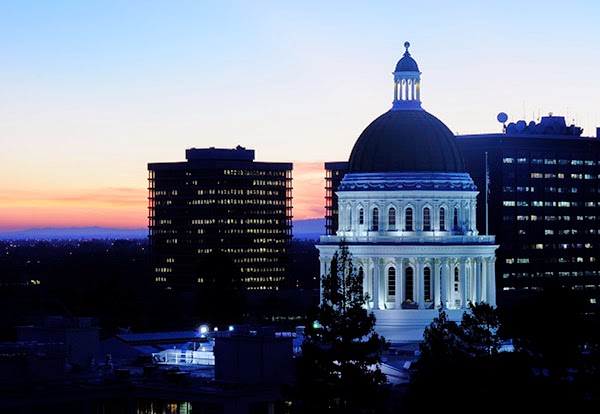
This image, I had to use Sacramento of course, was taken during a break in a dinner meeting.  I noticed the light was nice (often is at twilight) and I stepped out on the veranda for a quick image.  I have photographed the California Capitol several times but I had never spied it from this perspective.  As good as the postcards?  No, but after all, I was just a visitor.

Thursday, April 9, 2015

Inland Empire Museum of Art

There is a new player in Southern California’s Inland Empire art scene.  The Inland Empire Museum of Art is now at the table and showing her hand, featuring a full house of artworks.  The permanent collection begins a run at the Millard Sheets Art Center at the Fairplex in Pomona beginning this weekend.  The free opening reception is Sunday, April 12th from 2:30pm – 5:00pm.

The exhibit, Contemporary Art from California’s Inland Empire and Beyond, features over 175 works from more than 120 artists.  To see more information about the exhibit and opening reception click HERE.

I’m honored to have two of my pieces in this diverse collection, one of which will be on display for this exhibit.  The above image (click on the photo for a larger view) was captured in the Monument Valley region, where sweeping desert visas surround you while driving long, sometimes lonely stretches of highway.  Often you find roadside stands operated by local Native Americans selling a variety of creative works.  The contrast of “OPEN” yet empty caused me to jump on the brakes and set up a shot.

Using wide angle lenses is often a matter of finding, framing and composing an image that only includes enough and not too much.  Fortunately I was able to use the desolation of the environment as an advantage for this image.  When working with photographers over the years I have found that wide angle lenses (approximately 28mm or wider on a full frame or film camera or about 18mm on typical cropped framed sensors) often present challenges. We tend to get too much in the frame and, even with a great subject, the essence of what we were trying to capture is lost.

Wide angle lenses can be great for certain subjects but watch what is going on with the rest of your frame.  Check the edges of the viewfinder and the background before squeezing the shutter.  A tripod can be a good friend for moments like this. 

For more information about the Inland Empire Museum of Art visit the Web site at www.iearts.org.  I’m looking forward to attending the opening reception – hope you can make it as well!

Monday, April 6, 2015

First Images for Oregon State Parks

We were able to find an opening in the weather this weekend to venture out among the ferns and early blooming trillium at Silver Falls State Park for our first “official” photos for Oregon State Parks and Recreation.  We are very fortunate to have this gem of a park close to home.  The numerous falls may be the main attraction but there is so much else to this park, one of which is mountain biking.

My son and I opted for the gentler road at the 214 trailhead due to the recent rains.  This wide dirt lane has plenty of room for multiple trail users, including equestrians and families, and is a nice climb on a mountain bike as it skirts the forested hills and meadows.  Later we explored the upper part of the single track which is amazing!  Imagine rolling through fern covered hills under tall conifers on the type of dirt that is nearly silent under your tires as you take in the scent that is only found in forests like this.  This image is of my son on the 214 trail on his new bike.

One thing to remember when photographing in a forest is lighting is critical.  If you are seeking overall even tones then you hope the sun decides to hide behind some clouds for a moment, like it did here.  If the sun is out then you may have the option to look for something dramatic, such as streaks of light bending around trunks of trees.  Due to the high contrast, overall landscapes will often not photograph well.

For more information about Silver Falls State Park visit the Web site by clicking here:
Silver Falls State Park
In addition to a trail that leads behind the 177 foot drop of South Falls, the park offers camping, swimming and numerous options for day use activities.

Wednesday, April 1, 2015

We’re Going on an Adventure

We are embarking on a new journey with our photography this year.  Recently we met with some great people with the Oregon State Parks and Recreation Department and discussed helping them photograph areas around this amazing state.  After living in the Willamette Valley of Oregon for about 2 ½ years, we have explored many places but I feel as if we have merely ventured just inside the gate of Tolkien’s middle earth.  Forests, waterfalls, grand landscapes and maybe even a few Hobbit trails await!

Brochures are scattered atop maps next to computers, from the dining room table to the ottoman as we attempt to chart out our travels but…where do we start!  During the rest of the year expect posts from all reaches of the state, featuring an assortment of activities and reasons to come visit Oregon.  That’s how it started for us and now look where we live.

This volunteer opportunity will be a great way to keep looking for new ways to capture images that showcase all the State Parks, and other scenic locations, have to offer.  I bet there will even be some lessons along the way.  Check out the Oregon State Parks and Recreation Web site at www.oregonstateparks.org.  You will be hearing from us on the road soon.


Wednesday, March 18, 2015

Physics Lesson Part 2 – Inertia

The last post talked about stopping our momentum and making time to capture an image.  Now let’s look at another topic that keeps us from our best photos; inertia. 

So there we are…we actually stopped to take a look from a majestic overlook with tress sprouting fresh, vivid leaves.  The meadow is showcasing her splendor with swirls of flowers in bloom, and we have puffy clouds in the sky as if Ansel Adams himself had placed them there.  Life is good.

We are definitely going to take a picture here.  Lifting our viewfinder up to our eye, we notice that we can’t quite get the entire scene we envision using the lens that is currently on the camera.  A few minutes ago we were using our telephoto lens as brightly colored woodpeckers were working on a nearby tree.  Now we need a wider angle lens to capture this grand landscape. 

But…that lens in our camera bag…on the ground. 

I mean, I’m not lazy but I’ll have to bend over, take a lens off, put another on, and then stand back up.  I know for me excuses from the camera demon sitting on my shoulder is telling me things like, “Hey, those birds might be back, you will be sorry you changed lenses.  Looks pretty windy and dirty around here.  If you change you lens you may get dust in your camera!”

And then I remember not to let inertia get the best of me.  A body at rest, remains at rest, unless acted upon by an outside force.  We need to be that force!  Take a moment and grab that piece of equipment that will help you capture your vision of the scene if you really think it will help.  Be it a different lens, filter, sun shade – you invested in the equipment, feel free to use it!
The physics of falling in action with my son Bryce at Smith Rocks State Park.  You can’t capture this without the correct lens.

Tuesday, March 17, 2015

Momentum and Inertia in Photography

You may be thinking, “What does this type of science have to do with photography?”  Most of us don’t pick up a camera for the first time thinking about physics or motion equations.  Yet many times when we miss a great image it’s because of one of these two factors.

Let’s begin with momentum.  How many times have you been on a trip, visiting a garden or just wandering someplace with your camera, hoping to grab a nice image?  There we are, strolling down a path when you notice a nice flower specimen or come to overlook on the trail with a great view.  And then momentum takes over.  We know we should stop, at least to take a look and see if there is a worthy image, but momentum propels us onward.  Speaking for myself, I know many potentially great images were passed up this way.

The next time you find yourself hearing that little voice as your camera is whispering for you to stop and at least take a look through the viewfinder, try not to let momentum get the best of you.  Once I stopped letting the laws of physics rule over my photography I found I was coming away with more good images that I know would have been passed up on prior trips. 

Tiny climber on big wall at Smith Rocks, Oregon.  I stopped for this one.
(click on image for larger view)


Thursday, March 12, 2015

Our Perception of Color

While wandering the Internet, between kitten videos and political rants, I found “The Dress”.  Link after link, hashtag after hashtag, #thedress.  I relented and looked at what was causing all the fuss.  Something about a dress that some people see as white and gold, where others view it as blue and black; how different could these hues be?  Yet to others it changes colors.

So there I found myself staring at this bright white and gold dress.  I scrolled through the article and read a shallow but enjoyable description about how we view colors and white balance.  As I scrolled back up the page, I couldn’t find the original image of the white and gold dress; now there was a black and purple dress!  Finally something on the Internet that surprised me.

You can wander around the Net and find plenty of information about “The Dress” and it acts as a nice reminder for photographers, everyone sees things differently.  After leading many photo workshops I’ve seen this at work when a group of photographers all go to the same location.  The same scene is in front of everyone, but the person behind the camera sees something different as they press the shutter.  This is one of the reasons why I have photographs of locations I’ve visited, taken by other photographers, hanging on the walls of my house.  There have been many a critique session where I have seen two students like the other person’s photo better than their own. 

I’m glad we all see the dress differently.

Tuesday, March 10, 2015

Looking Like Winter


Flying into Philadelphia this weekend I spied a landscape mostly covered in white.  It was a perfect time to visit; the roads were nice and clear but it still had the feeling of winter.  Have you ever noticed how sometimes, even with a thick layer of snow on the ground, our photographs just don’t feel like winter?  Other times there may be just a thin layer of powder on the ground yet an image can have the sense we are looking into a snow globe.

There is a bit of a trick I learned on a trip to Vermont several years back.  There needs to be snow on the trees.  Snowflakes settling atop the boughs of trees give us the feeling of fresh snow.  We may not consciously think of it but this light layer on tops of branches, pine cones and other areas of trees only typically lasts a short time.  Photos that include this element remind us of a fresh snow storm.

This photo was captured by Lissa during one of our “spring” trips to Yosemite.  We had several years of snowy spring weather during visits to the Valley.  It snowed all night and just into the morning before this image was recorded.  A few snowflakes streak in front of the lens.  Although a color image, there is a decidedly monochrome feel to this image captured from atop the bridge near our campsite.  Spring break is a great time to visit Yosemite…just remember to bring a jacket!

Thursday, March 5, 2015

Low Light = Better Images

I remember when I saw the light, or actually lack thereof.  While perusing images in various publications over the course of several months I seemed to end up looking at images captured in low light.  Nighttime, artificially illuminated interiors, campfires and my favorite – twilight.  This was way back…about a dozen years ago…when digital was just starting to grow.  Film, specifically slides or transparencies, was the media of the day.

So there I was walking around Manchester, Vermont at twilight.  There was a building with a brightly illuminated interior and appropriate exterior lighting to match.  The sky was turning the purply-blue of twilight just after sunset.  Took some light meter readings, set up the tripod, scribbled notes and clicked away.  This was the start of about six months of this cycle and a great learning opportunity.  Unfortunately the feedback took days or weeks while waiting to get the film developed.

Enter digital with instant feedback.  What took me six months to master would now be compressed into a much shorter time.  One of my favorite classes to teach is night photography.  Students walk away from an evening with some nice images of subjects after the sun goes down, after their cameras traditionally would have been in the bag.

The photo above was captured at Portland’s Yard, Garden & Patio show from one of the display gardens.  The lighting is kept low in this area to help accent fire pits, path lights and other “outdoor” illumination.  I found the different light sources intriguing; the fireplace, the spa and light highlighting the artwork on the wall.  I hope this inspires you to keep your camera out of the bag a little bit longer in the evenings. 

Tuesday, March 3, 2015

Inspiration from Portland's Yard, Garden and Patio Show


Once again I attended the Garden Writers Association meeting at the Oregon Convention Center.  I was surrounded by inspiration.  First, at the actual show itself, ideas flowed from display gardens, other artists and, of course, plants.  Plants on display, for sale and used to fill out sample gardens.  The above image of a floating display of “helleborus” stopped me in my tracks. 

I knew there was little chance of an amazing image with convention center lighting and no tripod but there was no way to pass up a capturing this gem.  While standing there, it was interesting to see others drawn to this display (arranged by Lucy Hardiman at Perennial Partners).  It was placed at the corner if the table, no doubt by design, to draw folks like me to the area.  It worked. 

Elevated the ISO a bit, held my breath and grabbed a few frames of pure inspiration.  I’ll have to admit, never really gave these plants much of a look before now…how could I have missed this?!  It took viewing at them in a completely different way for me to finally see them.  Shame on me. 

Thank you to all the sponsors, partners and fellow GWA members at the meeting who were also responsible for refilling my inspiration tank. 

Monday, March 10, 2014

Composition – The art of placing items in your images

It’s a grand hall. The long walls filled with portraits painted by great European painters.  Yet at each end, two of the youngest people in the room command everyone’s attention.  They stare across the room at one another, seemingly unaware of all the other guests in the room. 

Pinkie - her flowing pink hat ribbons blowing in the breeze, toes pointed forward seemingly ready to dance from the canvas that holds here. 

Blue Boy - standing proud like a statue in his unmistakable blue outfit. 

As I stand before Pinkie gazing at the artist’s portrait, there is far more to notice than just another pretty face.  The canvas holds some great examples of composition and what it can do to enhance an image.  One of Pinkie’s ribbons falls from her hat, blown by an imaginary breeze. The fabric swoops down across her body, our eyes following the cloth as it drifts.  Her left hand is held in front of her just below the ribbon.  Her hand/arm and ribbon never cross.  This slight gap between her hand and the textile is a great lesson for photographers; sometimes elements of and image look better with space between them.

In nature think of flowers.  In some of our compositions we need to put a bit of space between a focal point and other objects. Pinkie provides us with a lovely example of this in practice.  However, as photographers we cannot always decide where something is placed.  Sure, maybe we can do a bit of scenic horticulture in our own garden and nudge offending plants out of the way.  Not going to happen if I need a Giant Sequoia placed in a different location! 

Should we always separate elements?  Pinkie provides us with yet another example as her two ribbons cross paths just a short way down the painting.  Is this breaking a rule?  No, the connecting lines lead us to see that her other ribbon is actually following the flow of her right shoulder before wandering out to the edge of the painting.

Many other paintings provide us lessons, showing where and when elements should be separated and when they work well together.  Our own images can do the same thing.  Take a moment to look over some of your own images to see if this concept is at work.  Many times we just know that it is pleasing to the eye without following a “rule”.  Thomas Lawrence completed this painting over 200 years ago, yet it still provides a lesson in our digital world.

Sunday, March 9, 2014

Painters Have it Easy!

I’ll admit it, sometimes I envy painters.  They are so fortunate when it comes to composition.  With a few strokes of the brush, the artist decides the location of a tree, excludes a distracting elements from the edge of the frame and places everything in exactly the perfect spot.  I mean, all they have to do is study and practice for years, learn how to mix colors, implement proper brush strokes and then spend days, weeks, months or longer on a project.  Okay, on second, my envy has subsided.

As photographers we can learn by studying painters and their craft.  During a recent visit to the Huntington Library, Art Collections and Botanical Gardens I took a detour from my usual route, which is typically strait to one of the garden areas.  I’ll admit it, I was a member off and on for years before I actually set foot into one of the buildings.  Yes, I’m easily distracted by colorful, shiny things in nature.  Over the past few years I’ve been retracing my steps to enjoy, and learn from, the classic art inside the walls. 

I had to force myself into the doorway of one of the buildings at the Huntington after arriving for a week-long stay.  California “winter” weather – clear, sunny, 78 degrees.  Oregon weather when I left – lots of liquid sunshine and 48 degrees.  Still, there was much to see in the grand galleries.

Numerous techniques cross over from painting to photography.  Few, if any, of these skills are new.  Most are centuries old, perfected by great painters over generations.  This is one of the first attributes we can learn, patience.  Whether it’s a sable brush or a digital camera in our hands, our skill develops over time.  I strongly believe digital cameras have increased the speed of our learning curve immensely, but learning, improving and perfecting a method (and our eye) takes time.  Sometimes lots of it.

Over the next few posts I’m going to explore some of the ways painters use light, composition, framing, posing and other skills in their bag of tricks…and how we as photographers can borrow these for our images.  My goal is for each post to be a mini-lesson.  The topics may act as reminders of techniques we have used in the past but lost track of over the years.

Each is intended to be a bite-sized portion; something to try next time you venture out with your camera, but not too overwhelming in scope.  I hope you enjoy our walk with the painters!

Tuesday, February 4, 2014


Different Perspectives – Putting your camera (and yourself) in unique places


“The clouds look so much prettier from this side”, announced the voice of the teenager leaning forward in her seat, positioning her cell phone camera for a better look out of the airplane window.  As I listened to the simulated shutter click on her phone I already had mine out.  She was right.  As our Boeing 737 lowered into the clouds as we approached PDX the sight was stunning. 

It was later in the day, a little before sunset, when the light begins to improve with each passing minute.  The clouds were really more of the thick fog that had been covering the Willamette Valley since just north of Eugene on the flight from, a much sunnier, California.  But as the plane slowed approaching the airport, the hills of Portland came alive, poking out of the layer of cotton enveloping the city.  Sometimes it was a large estate surrounded by a large, green pasture and a white fence.  Next another summit would pop out with no evidence of the hand of man – just pristine wilderness minutes from, and five hundred feet above the busy city. 

Other times there was no evidence of earth, just a silky weave of textures stretching endlessly to the western horizon.  In just the few minutes of the descent, the light continued to change as subtle hues danced atop the fabric.  Suddenly all was white as we plunged into the clouds.

As we emerged below, stringy lengths of grey fog hung from the cloud above.  The ever important light now flat.  It now seem night time; a stark contrast from the bright show just a few hundred feet above.  Both my neighbor and I return our phones to our pockets (many airlines now allow you to keep your phone on and in “airplane” mode for the entire flight). 

The young lady seated next to me on the flight absolutely had it right; we get better photos when we place our cameras in places that are unique.  In this case it was above the clouds but it doesn’t need to be in a faraway location.  When photographing young children, we can get our cameras closer to their eye level by kneeling down.  When traveling, photographing from higher (or lower) vantage points can provide a welcome fresh perspective.  It doesn’t need to be difficult, just try to get your camera in a different place other than your eye level on the beaten path.  Even if you click the shutter, you might enjoy the view yourself!


Monday, May 7, 2012

Fisheyes & Sun Flare

In Yosemite National Park there are plenty of reminders to look up.  Half Dome, Glacier Point, and numerous waterfalls just to name a few.  There is also, of course, the forest and the trees.  Using a fisheye lens (in this case a 10.5mm) while looking straight up creates a unique view.  Since the lens will cover most of the sky there is also the likelihood that the sun will be in the frame. 

By stopping the lens aperture down to a high number (small opening) and hiding most of the sun's light behind a tree, you will create a natural sun star without the need of any special filter.  You may also find some extra, colorful reflections across the image (notice diagonally down toward the lower left corner of the image there is a green circle).  This is a result of the bright light directly into the lens.

Sometimes you may wish to avoid this, other times enjoy the unpredictable nature, of nature.  Another advantage of finding a subject where you are pointing the camera directly up; you won't photograph your feet!  If you have ever thought about the possibilities a lens like this can bring to your photography, but you don't want to invest in such a special purpose lens, consider renting one for a few days or even a week.  That's what I did before I decided the investment was worth if (for me and my style of images). There are several local dealers that rent lenses and even cameras.

Tuesday, March 6, 2012

A Different Perspective

A Different Perspective
When we think of portraits, the visual is of someone’s face, a group or perhaps a profile.  There are times, many times, when a compelling image is actually captured from a far different perspective, from behind the subject. 

While enjoying the Chinese New Year celebration at the Huntington Library and Gardens I found that, while the fronts and profiles of many of the performers were interesting, the view from behind often made even a more compelling image.

By not showing the face you add mystery to the photograph.  This can work exceptionally well if you are telling a story with a series of images.  While some may show the face or faces, others can just show details or, as we have above, just the back of your subject.  Okay, I understand the portrait studios would not do too well if they showed a set of proofs to eager parents and none of them showed their precious baby’s face!  But after you get your great facial expression images, move around and show something different; like your subject from behind. 

Thursday, February 23, 2012

Memories of a different time
How our photography creates memories in a curious way

In 2003 I took a road trip, driving my 1988 Chevy S-10 Blazer, across the country to Vermont.  I was attending a photography business workshop and could have flown, but decided on driving across the county alone to see some new sights.  And of course take some photos along the way.

It’s hard to believe this was nearly ten years ago.  Sometimes if feels like it was a very distant time.  Other times the memories are quite fresh.  It was a great trip, great workshop and an all-around fantastic experience.  Shortly after this trip I donated my Blazer, with 444,000 miles, to a friend whose car had been stolen.  It was a nice farewell trip for the 15 years we shared together on the road.

There was one sight I spied while nearly home, just across the border in Arizona.  At the time it was quite humorous… dark humor about the price of gas.  Now we might see something similar now in 2012, but the fuel price would be substantially different…and higher.  How I wish for the 2003 version of what an arm and a leg looks like now!

Photographs provide great memories for our families, vacations and other events.  Sometimes the memories seem a bit twisted, like this sign, but they still are fun.  I think the lesson for me here was to stop and take the picture.  It was great coming across this image in my files recently.  Momentum could easily have gotten the best of me as I passed by this photo opportunity in the desert.  I had just traveled through more than two dozen states and was just one border crossing away from home.  Yet I overcame inertia, stopped the car and captured a memory.  Don’t let too many of these chances pass you by when you have easy access to a camera.

Friday, February 17, 2012

One goal down...getting started

Well, I set a goal to start a Blog in the first part of the year.  Here it is!  I'm looking forward to sharing stories, lessons learned and other bits I learn while behind the camera.  It looks like much of my learning will be sorting out the Blog controls for the first few posts so please hang with me for a while. 

Any insight you would like to share is always welcome.  I've been out with the camera quite a bit over the past few weeks and I'm looking forward to sharing some of the experiences I've had while looking through the viewfinder.  Thanks again for your patience and more to follow...soon.